All in a day’s work

I am very lucky in that I love my work, even if it exhausts me. I get to work with both pre-service and in-service teachers to build their confidence and capacity as teachers of mathematics. Not only that, I get to travel around the state to work in their schools.

My beautiful, but scruffy, late husband in the backyard of the house on the Peninsula.

I have worked in this capacity with in-service teachers (teachers who have completed their degrees and are working in schools) for seven years. The first four years saw me on the road for nearly seven months a year, living away from home and in temporary accommodation. When I first took on the role, I was living by myself, with a cat and a dog, 100 minutes from the airport and struggled to manage the work and travel load. Fortunately, Josh, my nephew, agreed to house share and I moved to a rented property closer to the airport, so the cat and dog still had someone to look after them and I was only 30 minutes from the home when I got off the plane, instead of what could be a two and a half drive from Melbourne airport to home on the Mornington Pennisula if I hit rush hour. It was a difficult choice, moving out of my beautiful home into rented accommodation but I loved the work I was doing and I didn’t want to go back to where I was pre-2015. (I took that year off and did my Masters.) That choice started breaking the emotional thread that attached me to that particular house, which enabled me to sell it 2 years later and then nearly 3 years ago now, even move states.

After 4 amazing years with AMSI, I decided to start a new job, buy a new house and return to study, all in South Australia. And because I never do things by halves, I packed everything up, put it on a truck, and sent it to SA with Josh, (he flew,) while I drove across with the cat and dog on what turned out to be the hottest day of the year (only 46 C,) arriving late Friday. I then started my new job on Monday followed a week later with beginning my PhD. When undergrad classes began in March, I took up a bit of tutoring, just for the hell of it.

My Kangaroo Island Lockdown

My new job enabled me to continue working with in-service teachers and instead of working in two states while living in a third, I got to travel all over South Australia. This happened throughout 2020, 2021 & 2022, even though there were a few last-minute cancellations with schools having COVID restrictions to enforce. However, unlike both Victoria and NSW, we didn’t have major lockdowns. In fact, besides the first rush to stop the spread in March/April 2020, SA only had two snap lockdowns; one in November 2020 and the other in July 2021. Both times, I was not in Adelaide – in November 2020 I was on Kangaroo Island, and in July 2021 I was in Cobber Pedy. The first time, no one had any idea about what was happening, whether flights would be grounded, if everyone had to go home or stay put. I couldn’t get off the island so I just stayed put as I couldn’t contact the airline I was flying with and my work colleague back in Adelaide couldn’t either. I guess they were completely overwhelmed with enquiries as everyone want to know what they could and couldn’t do. I phoned the police on KI to find out if they knew what the rules were and their response was, “We’re in the dark as much as you are.” So I went to the hotel/motel where I was staying and asked to be moved into a room with cooking facilities and a washing machine; I was only supposed to be on KI for 2 nights 3 days so I only had 2 changes of clothes. I moved to a great spot overlooking the ocean and spent 4 days watching the weather outside my room. (The initial lockdown was supposed to be 6 days, but it turned out someone lied about how they contracted COVID, so the travel restrictions were lifted after 3. I left on the first available flight because although the lockdown had ended, DfE schools weren’t allowed to let non-staff members on site.)

The Mud Hut Motel, Coober Pedy

The second lockdown was in a slightly different environment; Coober Pedy. I had flown up on Monday for a week working in the school. Woke up Tuesday morning to find that the Road House was under ‘outdoor’ dining restrictions; by 4 pm, the entire state was in lockdown. Trying to leave Coober Pedy wasn’t an option; it only has 3 flights to Adelaide per week and anyone who could, booked on the Wednesday flight. As I was due to fly out on Friday, I just stayed out. Where I stay when in Coober Pedy (The Mud Hut Motel) is really comfortable, so it wasn’t a penance. Food was a bit of an issue as I usually eat out when up there rather than cook for myself, but I managed to find stuff at the minimart at the Road House. Flew back to Adelaide on Friday and drove home through very quiet streets.

Sunset, Coober Pedy

Visiting Coober Pedy is always interesting as you are never sure what you’ll get. On one visit I took all my food with me because there had been massive floods in and around the place and the main highway, Stuart Highway, was cut in both directions. As a result trucks with supplies weren’t getting through and with tourists stuck in the town and dwindling fresh food, I thought I had better go prepared. The other problem was, with the road out the plane was loaded with extra freight, so they were bumping off the luggage of passengers that were over the limit. For me, the choice was either my work stuff or the food. Fortunately, at the last minute, someone offered to unload something that was actually supposed to be going to Port Lincoln; why the hell it was being sent to Coober Pedy, nearly 900km north of Port Lincoln in the first place is a bit of a mystery.

Town landscape, Coober Pedy

My latest visit was also a bit of a journey. The plane left an hour and a half late and took 30 minutes longer than usual, due to headwinds. Sunday, the day before, Coober Pedy, and a number of other small outback communities had been hit by wild weather, knocking out power supplies and causing a bit of flash flooding; 35mm fell in a couple of hours where the long-term average for the entire month of October is 14 mm with winds gusting to 102 km/h. If there had been trees, there would have been trees down but there are no big trees in Coober Pedy. It was nowhere near as windy on Monday but it was a pretty bumpy ride. Just as well I was weaned on single-engine aeroplane flights in the territory in the mid-eighties. It makes air turbulence in bigger planes a lot less scary. The wind was up in Coober Pedy all of Monday and Tuesday before dying down but fortunately, all the rain meant the dust was not.

These are just some of my adventures over the past 3 years, doing a job I love but the travelling does get a bit wearing at times.

If you think adventure is dangerous, try routine. It’s Lethal!

Paulo Coelho

What’s on your bucket list?

When it comes to my bucket list, the blame sits fairly and squarely with Netflix. When I first signed up for Netflix during my AMSI travel days, I came across a series titled “Chef’s Table.” The first series took you from Modena, Italy, to Järpen, Sweden, via New York, Buenos Aires, LA and Melbourne. The documentaries let you into the world of these amazingly innovative, passionate, but slightly crazy, obsessive chefs as they create food to tantalise the senses. I avidly watched each series as it became available and my bucket list began to form – to visit the top restaurants on every continent and saviour the sensory experience of great food, drink and atmosphere.

The only problem; well, possibly not the only problem. Things like global pandemics, wars, and in all truth, finding the time to do it also come into play. But the big one is lack of money, which is why I don’t have the time; I’m too busy earning money for the daily necessities that travelling to all those places, just to have a meal seems a bit ‘pie in the sky.’

When I started writing this postn it was coming into winter here in Adelaide, South Australia with long nights and short days. On a Friday, I started work before 8 and don’t finish until after 6, so I was up in the dark and home in the dark. It was also getting cold; not cold in comparison to other places in the world, but cold by our standards; Still not at the shortest day, and spring, a long way off. The quote below sums up my feelings about winter. Taking steps to survive the winter and find some joy is a necessity. Fortunately for me, I just needed to make it to July when I would have 12 days of warmth in The Philippines.

So, how does this link to my bucket list, you ask in my delusional imagination? No, I was not suddenly jetting off to Copenhagen, Denmark, to dine at Noma, or Atxondo, Spain, to experience Asador Etxebarri’s delights, nor to the closer Odette in Singapore. (Mind you, having looked at the offerings in Singapore, I have booked a flight and a week in January.) I have been sampling the fare on offer here in Adelaide. Josh, my nephew, and I are trying out the top restaurants on a Monday evening when work, travel and other social happenings allow it. SO during those long cold weeks throughout May and June, we journeyed out.

Raw tuna, edamame, black rice with bonito cream and grilled nori

Firstly was Shobosho on Leigh Street in the CBD (https://shobosho.com.au/), which is listed across most, if not all, top restaurant www guides, and it did not disappoint. The raw tuna, edamame, black rice with bonito cream and grilled nori dish was delicious, as were the dumplings. My main was wood roast cumin Lamb Ribs with black vinegar and braised leeks. Definitely worth the trip out on a cold winter evening. The atmosphere and service were also good. The bustle and hum of the restaurant on a Monday in May attested to its popularity. I will, without a doubt, visit again and, this time, take photos of the food. I get preoccupied watching the working of the kitchen and the restaurant as a whole, I don’t remember to take a photo until halfway through the dish.

The following Monday we ventured out again, this time to Osteria Oggi on Pirie Street, also in the CBD. This restaurant also rates well in most guides, but we did not enjoy the experience as much as expected. Our first courses of Tripe (Josh) and Smoked Kingfish Crostini were yummy but the pasta dishes we had weren’t overly inspiring. I had Pappardelle with rabbit ragu, which while very tasty was overly salty. Josh had Squid Ink Fiori with prawns, pipis, and samphire, which looked impressive on the plate but not the palate.

The final restaurant visited was Fishbank on King William Street and, boy, was it a beauty. Everything from the interior, to the service, drinks and food was top-notch. In fact, it was so good, we went back again to try other dishes. Sited where Jamie Oliver had his Italian restaurant, Fishbank’s food is well-worth several visits. It’s delicious and beautifully presented. On one visit I had the steamed whole baby snapper, while on the other I tried a selection of their snacks and small plates. Fishbank also has an excellent selection of wines, spirits, cocktails and other beverages, SO if you are in Adelaide and you like fish, definitely put it on your bucket list.

https://fishbankadl.com.au/ Jack Fenby

Unfortunately, due to work and other things getting in the way of Monday nights, we haven’t venged out anywhere new recently, but that’s fine because when next winter arrives, and it is dark, cold and dreary, we can continue our exploration.

Define ‘holiday.’

So what constitutes a holiday?

from https://www.dictionary.com/browse/holiday

I didn’t know about number 6, but I have certainly created holidays when painting. Perhaps ‘vacation’ is a more appropriate word:

from https://www.dictionary.com/browse/vacation

I have had the first real vacation in years, 14 days ‘… of suspension of work, study or other activities,’ that require effort and energy. Sure, I’ve had ‘holidays’ over the past few years, but I realise I have always been busy doing, not actually resting. In the past 14 days, I have just done what needed to be done and little else. It has been great! I thought I’d be bored by now but, no, I’m not, although I did decide to start writing this blog again. Occasionally I experience pangs of guilt when I think about all the presentations I need to prepare for work, but when that happens, I actively seek out another K-drama on Netflix or Viki to watch. I have until Tuesday before I start my new part-time role, returning the following week to my present part-time job. I could talk about my two jobs, both of which I love, but I’m vacationing so I’m going to explain why my last holidays were not vacations.

September 2020 was my last holiday. It was my sixtieth birthday, and as ‘zero’ birthdays are supposed to have some significance, I was supposed to celebrate it with a house party and friends. Unfortunately, there were a couple of problems. One was that I moved States in January 2020 from Victoria to South Australia. As most of my friends live in Victoria, it would take some organising, but I was up for it. It turned out another unexpected problem was a more significant issue; COVID. Everyone was in lockdown and couldn’t come anyway. So I did what any self-respecting independent woman would do; I went and spent the week by myself. I know, but I thought I’d have a bit of me-time prior to a working week. We had visits scheduled at schools on Kangaroo Island, so I went down the week before to just relax. I chose a beautiful place, overlooking the ocean, in the middle of nowhere. The problem was, it was in the middle of nowhere, an hour to the nearest shop, on unlit and unsealed roads with no phone. It would have been great for a romantic weekend, but I got bored, resulting in me driving all over the island. Got some great photos and saw the devastation caused by the summer fires, but didn’t get much rest.

My previous holiday was even crazier. I went home to New Zealand and proceeded to do a ‘cousie’ road trip, i.e., I visited all my cousins and family in the South Island in 10 days. This involved literally travelling from one end to the other. I started in Christchurch with breakfast with Cousin Andrew, drove to Kaikoura and spent 2 nights with Cousin Susan and family. I then stopped in Blenheim to lunch with a friend before driving to Wakefield to stay with Bob and Esther (brother and sister-in-law). While in the area, I caught up with my eldest brother (Bill) and his family, as well as Cousins Peter and John. After a few days, I hit the road again, heading for Invercargill via the West Coast, traversing the Alps at the Haast Pass. I met my cousin Janine in Invercargill, and we headed to Riverton for 2 nights. Next, I drove up to Dunedin, where I had lunch with my niece Jane, before driving to Christchurch and finishing the day with dinner with my niece Claire. I then flew back to Melbourne to start work. If you are not tired from reading that, I’m exhausted just writing it. Got some great photos though!

Ella and Zerlina travelling to Adelaide

I didn’t have a holiday between finishing my last job and beginning my present one; I decided to pack up and move States instead. That was fun, NOT! Organising, packing, selling, cleaning after 16 years living in Victoria was draining, to say the least. Then the drive to Adelaide turned out to be on a sweltering day in Victoria (440 C), with Ella and Zerlina in the car. The heat was moving east as it had been 440 C in Adelaide the day before, so after driving through to sweltering Victoria, we got hit with almighty thunder and lightning storms as we crossed the border into South Australia.

I guess what constitutes a holiday depends on what you want to get out of it, be it rest, experiences, family time, travel, relaxation or a combination of them all. Sometimes you have to travel distance to find it, while other times, it’s at home, in your own space. I’ll finish with a photo taken recently when I decided I just needed to sit by the sea, feel the seabreeze and watch a sunset. Wherever you are spending your holiday, I hope you get what you wanted from it, particularly during these more difficult times as we deal with a COVID normal world.

Glenelg Beach South Australia

“Damn it! Someone will know what I had to say.”

I haven’t written anything for ages, mainly due to laziness, life, and why bother. I have been on holiday, i.e. not working, for a total of 14 days. This is totally unusual for me. Even when I am on ‘holiday,’ I am busy doing stuff. SO why start to write again? I have trouble sleeping; my brain is often way too active. My sleeping aid, rather than drugs, is listening to an audiobook. I always listen to the same one. I concentrate on the story if it is a different book, which keeps me awake. I listen to Andy Weir’s “The Martian,” read by RC Bray. I first listened to this story back when I was travelling through vast tracts of the Australian Outback, visiting places that at times could have been on Mars, except with air and plants. Sometimes the air was too hot to breathe, and the plants were scarce. There was something comforting about the style of writing and the narration that made the kilometres roll by without distracting from the road and the on-coming traffic. Now there is the same comfort in helping me drift off to sleep. As you may surmise, I don’t listen to “The Martian” while driving anymore.

Top of the Spencer Gulf, Port Augusta, South Australia
The road to Marble Bar, Western Australia
Red Dirt, near Port Hedland, Western Australia

Anyway, back to why I decided to start writing again. Last night, as I was waiting to drift off to sleep, Mark Watney was recording his thoughts on being the first to do lots of things he never planned on doing, lamenting on being the first person to be alone on an entire planet and how he wishes he could talk to someone.

Jesus Christ, I’d give anything for a five-minute conversation with anyone. Anyone, anywhere. About anything. I’m the first person to be alone on an entire planet. Okay, enough moping. I am having a conversation with someone: whoever reads this log. It’s a bit one-sided but it’ll have to do. I might die, but damn it, someone will know what I had to say.

Andy Weir -The Martian

I spent some time yesterday rereading my travel blog and the previous posts on this blog, and as I listened, drifting off to sleep, I thought about them and how much I enjoyed writing, sharing my photos of and thoughts on my experiences. As a result of my late night/early morning musings, I am writing this. Does it matter that I may be the only one who reads this? No. Does it matter if I write spasmodically? No. Does it matter if the topics are mixed and varied? No. In the words of Mark Watney, “… but damn it, someone will know what I had to say.”

“What dreadful hot weather we have! It keeps one in a continual state of inelegance.” Jane Austen

Sorry to be harping on about hot weather, but it is does sort of dominate your life at times. My favourite quote is:

“The heat index is somewhere between OMG and WTF.” (anon)

I’m just going to share some photos in this post that I’ve taken over the past couple of days.

The wind dropped out at Marble Bar on Friday and I got to fly my drone.  A storm was coming in so there were clouds gathering. 1573801597568

This first one is down at the actual Marble Bar pool. The ‘marble’ is actual jasper but whatever it’s geological makeup, it’s a pretty place to visit even with heat and flies (DON’T GET ME STARTED ON THE FLIES!)


1573802747272

Afterwards, I drove to the flying fox lookout, which is up above the river. I got a couple of photos but, even though it was overcast, the air was still hot and the little fella heated up very quickly.  The drone camera seems to have a more grey cast to the photos, making the dirt brown and the grass turfs grey green, which isn’t really their colour at all. The 2 photos below are a far better representation of the true colours.

MBNov193MBNov195

The hills all round Marble Bar are rough red rock with spinifex grass.  At the moment, all the spinifex is golden brown, so the contrast between the rust red rocks and the golden spinifex is eye-catching. The photo below was taken in February, after good rain, just to show the contrast in the spinifex.img_1242-001

The road to Marble Bar is an easy drive with a major upgrade finally finished.  There are a number of smaller mines out that way, so the infrastructure needs to deal with heavy 60 metre quad road trains.  While iron ore is the main mining focus in the Pilbara, there is an increasing number of operations looking for and extracting copper, rare earth metals, gold, and some minerals I have never heard of (molybdenum and tantalum for example,) from out of the way places.  If you look at Google maps closely, you will find accommodation complexes, some very weird but definitely man-made markings, and man-made holes in the ground.

20191115_162748

Driving back in to Port Hedland on Friday, there were occasional patches of showers and huge wind gusts, enough to make it hard driving.  At one stage the visibility was pretty poor due to amount of dust being kicked up.

R2MBNov1972

Unfortunately, there was no rain in Port Hedland, just increased humidity.  Saturday morning after breakfast, I walked down to the edge of the harbour entrance channel; it was low tide.  I had been meaning to do it for some time. The first photo below was taken Saturday while the bottom two show different weather conditions, taken at different times of the year. The leisure boat in the top photo is moving away from the jetty shown in the bottom two.

20191116_091834


The most exciting thing was I saw a turtle while on the edge. It is turtle nesting time up here at the moment.

20191116_091816

By the time I got back to the car, after only half an hour, I was feeling a little heat stressed, so I checked the temperature…it was already 41 degrees, so I went home and spent the rest of the day inside in air-conditioning. I could not find anything that kept me occupied for longer that 30 minutes, so boredom drove me to bed at 8 pm.

“I’m bored’ is a useless thing to say. I mean, you live in a great, big, vast world that you’ve seen none percent of. Even the inside of your own mind is endless; it goes on forever, inwardly, do you understand? The fact that you’re alive is amazing, so you don’t get to say ‘I’m bored.”
Louis C.K.

On Sunday, I decided I couldn’t spend another day doing nothing, so after breakfast took after towards Broome. Earlier I decided to look up on trip advisor what there was to see/do between Port Hedland and Broome and the 6 answers included, besides Eighty-Mile Beach, ‘buy petrol,’ ‘One long road and whole lot of red dust,’ ‘I spy with my little eye, something beginning with “N”….Nothing,’ and ‘This topic has been closed to new posts due to inactivity.’  On the 600km drive between Port Hedland and Broome are two roadhouses, Pardoo and Sandfire, but off the Great Northern Highway are some semi-hidden gems.

Road to PH
Somewhere between Eighty-Mile Beach turn off and Pardoo.

Not far, by Pilbara standards, at only 250kms, is Eighty Mile Beach Caravan Park, which is a good entry place for Eighty Mile Beach. It is a thin strip of beach that actually runs for 220 km (140 miles) between the Great Sand Desert and the Indian Ocean, from Cape Keraudren at the Port Hedland end and Cape Missiessy at the other end. On the ocean side the sand is white, while on the land side of the dunes, the dirt is red.  The contrast to something to see.  These photos were taken with my drone.

15739656784482.jpg
Red and White contrast; sand and dirt.

To be perfectly honest, on a hot day, you’re not going to spend too much time out of the sand; it’s very inhospitable. During winter, when the weather is just right, it is a very different view on the weekend, with vehicles and people spread out for miles in both directions.

So after a very quick visit and the “walking on hot sand” dance, I jumped back in the car and headed for Cape Keraudren, which is a coastal reserve, and a bit of a surprise.(http://www.eastpilbara.wa.gov.au/Our-Region/East-Pilbara-tourism/Cape-Keraudren)   It is stunningly beautiful with stark contrasts between white sand and red rocks. There are mangroves, tidal creeks, mudflats, rocky shires, incredibly white sand, salt pans and wild life.  Apparently it is also the northern end of the Rabbit Proof fence. It’s a popular place for fishing and crabbing and just vegging out.

20191117_141557
The very start of Eighty-Mile Beach, Cape Keraudren

20191117_142748
Alone on the sand, Cape Keraudren

20191117_150202-001
West side of Cape Keraudren.

20191117_144749-001
East side of Cape Keraudren.

I saw Brolgas, an osprey, a kangaroo and dozens of little wading birds.

wildlife1
Wading birds, Cape Keraudren

IMG_4844-001
If it wasn’t for their red heads, brolgas would blend into their surroundings.

It was a great way to spend my Sunday.  Some people might think spending it driving 550km isn’t that enjoyable, but, as I’ve said before, distance is relative.

I thought I’d finish with some Broome photos taken during one of my visits over the past four years, as I have talked about Broome, i.e there’s nothing between Port Hedland and Broome. Cable Beach is considered to be an amazing place to see the sunset, because there is nothing between you and the horizon. The moon rise at low tide, referred to as the Staircase to the Moon, at Town Beach, is also pretty spectacular.  Enjoy.

IMG_3685-001
Camel rides at sunset on Cable Beach, Broome.

staircase to the moon1
Staircase to the moon, Town Beach, Broome

sunsetCB1
Sunset, Cable Beach, Broome

“You can shake the sand from your shoes, but it will never leave your soul.”

Arrived back in Port Hedland, stepped off the plane into the heat and humidity, and breathed in with pleasure. I always experience a feeling of coming home when I step off the plane even though I doubt I could seriously live here; not because of the weather but the lack of things to do.  I’m not into camping or sports, there’s not a lot of restaurants, although there are a couple of really good ones.  This time of the year, with the heat closing in, people tend to move inside because it’s too damn hot outside.

porthedlandtemp
Screen shot of the week.

The humidity can get as low as 5% as the heat burns it off, then, come evening, it bounces back up.  It was at 48% when I got off the plane Monday night. Friday I’m heading out to Marble Bar with an expected max of 45.  The thing you notice the most on these hot days is the air temperature, which is hot, even in the shade; you are completely surrounded by hot dry heat.  As I walked from a classroom to the admin block, it was 41 and 8% humidity; I could feel the moisture being sucked out of my body. You have to hydrate not just your body but your skin as well. This is why people die when they go walking in the midday sun.  Even if you take water with you, it’s probably not enough for your body’s needs.  I have drunk about 1 and half litres of water today and I know it wasn’t enough because I am developing a headache, and I was sitting inside in air conditioning for 80% of the day and only went for a walk when it had cooled down to 35.

There’s something about the big sky country of the Australian Outback that is summed up in the quote, “You can shake the sand out of your shoes, but it will never leave your soul.” Mind you, sometimes you can’t get the dirt off your shoes; I have several pairs of shoes that are stained red from the Pilbara dirt. It’s probably why I buy pinkish shoes; it doesn’t show as much. It may be hostile but it is so beautiful.  There is nothing soft and gentle about it, even on the east coast; there is a sense of raw energy.

It is really interesting to look at the early oil on canvas landscapes of the Australian bush. These early artists were trained in England and they represented the country with a softer light and the wrong colours.  The prominent colour in so much of Australia is red, follow by a silvery green of the gums, yet they used brown and deep green.  It took time and a change in style (Australian Impressionism) for the real Australian colours to be present.  If you wander through one of the main art galleries, after awhile you begin to notice the difference in those that accepted the hash, bright light and those that continued to dream of Australia as England down under. Have a look at the following website for a more informed view: www.montmarte.net/creativeconnection/articles/show/a-short-history-of-early-landscape-art-in-australia.

20191113_1454406881414360067883192.jpgThe contrasts that exist in the Pilbara are amazing and I’ll show you a few in the next post, but at the moment, at this time of the year, it is simply hot.  It’s a bit like the build up in the Top End which at this time of the year, it gets more and more humid until it just has to rain and everything cools down and then it starts all over again.  Here, it’s not the humidity that’s the killer; it’s the heat. It builds and builds, then a ‘cool’ change comes through and it drops to …. 38.

This photo is of the sandwich container (minus sandwich) which I left in the car all day. And by the by, the rental vehicle I got this trip has leather seats; sounds grand doesn’t it, but you should try sitting on one, in a dress, after the car has been sitting in the sun all day.  I need to put a towel over the seat before I receive 3rd degree burns!

I wasn’t going to talk about maths in this post but I watched a great lesson Wednesday and I want to share.  Year 7 class, introduction to algebraic equations.  The teacher brought a balance scale into the classroom and used it to demonstrate balancing equations.  He initially set it up with 3 pen lids on one side and 15 1 cm3 blocks on the other, asking the question, what was 1 pen lid equal to?  The students pretty quickly suggested 5 1 cm3 blocks were the same as one pen lid, so they tested it and, sure enough, that was right.  Next the teacher added 2 1 cm3 blocks to each side asking is it still balanced and why. He then physically set up another problem, with 2 pen lids and 3 1 cm3 blocks on one side and 13 1 cm3 blocks on the other. He then walked the students through the CRA process. CRA stands for concrete, representational, abstract. What it looked like is below:

Sven'sLessonThey then repeated with yellow weights that looked like a sombrero, which they labelled as ‘s.’ The students were totally engaged, which for this group was pretty impressive, and they were solving algebraic equations without realising it.  When the teacher informed them the end of the lesson, they were all pretty impressed with themselves.


I’m hoping to fly my drone sometime this week but it’s really windy.  I’m off to Marble Bar tomorrow, so I think I’ll take it with me and see if I can get some shots. I’ll also be taking a lot of water, just to be on the safe side.  You don’t want to break down in 45 degree heat and be short of water.

Signing off with a sunset taken at the salt ponds here in Port Hedland.

20191114_1801399037628130620508000.jpg


“Now this is not the end.”

Now this is not the end. It is not even the beginning of the end. But it is, perhaps, the end of the beginning. Winston Churchill

First last days started this week; it’s sad, that after 4 years of visiting these school, their staff and students, there will be no, “I’ll see you next term,” as I walk out the door. Having said that, I am excited about the future so really, like Churchill’s sentiment, it is the end of the beginning. I have spent the last 4 years learning so I can confidently move to the next stage. I guess leaving the people I have met in Port Augusta isn’t too upsetting as I will be coming back in some role or another, and I will still be in contact and see many of them in and around Adelaide.

This week, I have had a number of discussion around planning for next year and what should be taught first. I have a number of views in this and most of them are not, as far as I’m aware, research based, but the result of years of teaching, talking with other teachers and the round-about of education. If you disagree, sorry and if you have research to demonstrate what I think is wrong, please point me in that direction.

I talk to teachers at all year levels about the importance of putting maths in context and my personal belief that starting with fractions, time, money and/or measurement, depending on the year level, are as good a place to begin the teaching and learning year as any.

Telling time using an analogue clock is a dying skill as most people, these days, use digital time. If you want students to learn to tell the time using an analogue clock then you have to give it a purpose. So teach it at the beginning of the year then, as the teacher, make the commitment to refer the students to the clock constantly. When they ask, “Can I go to the toilet/get a drink? What times lunch/recess/home time/PE? How much longer until…?” respond, according to level, “At quarter past/half past/quarter to/ 5 past/ 20 past etc., in 10 minutes, in five minutes….” Always look at the clock and refer the students to it, expect them to use the clock to tell the time and not view it as a room decoration. Time then becomes part of everyday life and not a 2 week unit. Once upon a time, (okay, when I was young, which was some time ago,) getting a wristwatch was considered a milestone, and it was an analogue watch, not digital. Most wristwatches are now digital; Fitbits or something similar.

Set up a classroom economy at the beginning of the year and have the students managing it by the beginning of term 2. Again this builds in money as an ongoing teaching and learning strategy rather than a ‘two week’ unit and it becomes part of everyday schoolroom life. There are lots of websites on the classroom economy as it can be adapted to work for all age levels. I have seen it working very well in a year 1/2 class, as well as in year 6 level. The sophistication of the economy is dependent on the year level, but, again, you as the teacher, must commit to it.

strip_fractions2

“Why my half bigger than your?” Reinforcing the concept that the size of the half is dependent on the size of the whole or collection.

strip_fractions3

Why fractions early on? In the national curriculum in Australia, half past and half are taught in Year 1; half, quarters and eighths of objects (whole) and collections and quarter to and quarter past are taught in Year 2; the concept of unit fractions and their multiples in year 3 along with telling time to the nearest minute, which, personal, I think is a huge jump so would focus on five minute intervals. Beyond Year 3, the curriculum begins to contain an increasing amount of content, with a lot of which is fractions, decimals and percentages focused. By the time students are in Year 6, more than 50% of the achievement standard has this focus, yet, in all honesty, these extremely important concepts are addressed as a separate unit of work maybe in term 3 for a few weeks and less than 25% of the teaching and learning time is spent on it.

Lastly, measurement. If you unpack the using units of measurement component of the Measurement and Geometry strand, the following action verbs reoccur; compare, order, measure, convert, all of which use number. Even in years 1 & 2 where uniform informal units are used there are opportunities to link measurements and number particularly with the extended subtraction concepts of missing addend and comparison.

My foot is 12 unifix long but I only have 8. How many more unifix do I need? or My height is 16 paddle pop sticks, Jane’s height is 10 paddle pop sticks. What’s the difference in paddle pop sticks?

Often strands are taught separately with students not seeing the connections between them, while teachers struggle with the ‘crowded curriculum.’ In Year 6 a content descriptor in the Measurement strand clearly states ‘connect decimal representations to the metric system’ while in the Number strand ‘multiple and divide decimals by powers of 10’ directly supports ‘convert between common metric units…’

Off back to Melbourne for 2 nights then back on the plane for my final trip to Port Hedland. Safe travels everyone.

PA_SpencerGulf_Stillness1
The stillness that settles at times over the Spencer Gulf, SA

20190919_1347346707229222737943684.jpg
Same view at low tide and when it’s blowing a gale and dust is whipped up

SO it begins….

I am going to try and do a post a week for the next 8 weeks as the count down to the end of the year and the completion of my role as an AMSI ORO (Outreach Officer) begins.  Today, Sunday, I am up early and at the airport to catch a flight to Adelaide, South Australia.  From there I pick up a car and drive 310 km to Port Augusta.  I quite enjoy the drive as, while it can be very busy, it is a good road. The wonderful people at the Majestic Oasis Apartments look out for me and if I’m later than expected they check to make sure I’m okay.  As a single traveler, frequently on the road, I greatly appreciate this as it’s nice to know someone is watching your back.  I always get one of two rooms from where I have taken many photos of the Spencer Gulf.

Port_Augusta6
View from the balcony, calm Spencer Gulf.

As I said I quite enjoy the drive.  Sometimes on the way back to Adelaide, if the road is really busy, full of grey nomads and road trains, I will turn off and head for Wilmington and take the route through the Clare Valley, which takes longer but is quieter and prettier.  If I have time I love wandering through the back roads of the Yorke Peninsula.  The settler history of South Australia is fascinating and scattered all over the Flinders Ranges and the Yorke Peninsula.  As I am moving to Adelaide in the new year, I will have the opportunity to capture digitally as many of these old places as I can.  Maybe I’ll have an exhibition sometime.

YorkePenoldhouse1-001img_1857-001img_1913-001.jpgYorkePenoldhouse2-001

I have got used to driving long distances over the past 4 years. I remember my first long drives in the Territory were a lot more difficult and Tim did most of the driving.  The trick is to have a good book to listen to…Yay for audio books on mobile; no changing discs. Music tends to allow the brain to wander, which isn’t great when you are driving or it puts me to sleep (also not good.)  A number of my colleagues recommend podcasts particularly true crimes but not really my cup of tea.

I have been very fortunate to have had the role of ORO for 4 years.  I have learnt so much about the teaching and learning (T’n’L) of maths which has made me even more passionate about the importance of increasing engagement in maths and developing teacher confidence and capacity.  Some of the most interesting aspect of T’n’L that I have learnt over the past 4 years have been not the actual content or pedagogy but the neuroscience, the mindset and the psychology of learning.  I have thoroughly enjoyed developing my own depth of understanding around the T’n’L of fractions, decimals, ratios, rates and proportional reasoning.  I always knew these were important components of mathematics but the research that demonstrates the direct links between competence in fractions and division in years 5 and 6 and general mathematical understanding and success at years 10 and 11 was a revelation.

playdoh7
I’ll share this activity in a later post.

It was, however, the understanding of how the brain learns, the importance of mindset and adolescents’ beliefs when it comes to learning maths that have really challenged my way of thinking about T’n’L of mathematics.  Students ‘switch on and switch off’ maths and often it takes only one teacher to do either.  Maths is the poor cousin to English.  As  maths teachers, when asked what you do, are generally greeted with comments such as “I hate maths,” “I’m hopeless at maths,” “I had the worst maths teachers, that why I can’t do maths,” “I’m not a maths person,” or something of similar ilk.  Maybe occasionally you might get a story about a great maths teacher and how they really help build confidence and self-perception of the speaker as a maths learner.  If you announce that you’re an English teacher, you seldom get, “I had English” or “I’m hopeless at English.”  We have to address the negativity around maths that exists in the wider community.  And while parents’ perceptions and beliefs play a big role, we, as educators, must strive to make maths most relevant, useful and interesting in schools.  And NO I am not talking about making it FUN.  Professor Di Siemon, a well respected Australian mathematics educator, talks about success breeding engagement, not the other way around.

Bells and whistles will not guarantee success.  Which is a problem when an excited teacher talks about how fantastic a lesson was, and a colleague asks for the lesson so they can ‘do it’ too.  The first teacher may have delivered that lesson as the 3rd, 4th even 5th lesson in a sequence with the students experiencing success along the way, building their confidence and capacity.  getsmart37A one-off lesson, removed from its basis, is not going to have the same impact. David Ingham, a former mentor of mine, called these the Kaos Torturer’s theory of teaching. Max is strapped to the torture table while the Kaos torturer consults the Koas Book of Torture.  He finally finds something and says, “That’s a goodie.”  It is obvious he’s already tried something else which hasn’t worked even though it should but Max seems immuned. Too many lessons are presented as ‘goodies’ rather than considering what is really needed.


I am going leave it there for today as I have now arrived in Port Augusta.  I want to talk more about Di Siemon’s work in the Big Ideas in Number,  the work of Dr David A Sousa’s on how the brain learns and Professor Jo Boaler’s work on Mathematical Mindsets.  Along with research into adolescents’ engagement and disengagement in maths and maths anxiety, these 3 have had a big impact on how I think about the T’n’L of mathematics in both primary and secondary schools.

I’m finishing with a sunset, taken in Port Augusta, but not today.  I am planning to try out my drone tonight which I have recently bought. Hopefully some interesting photos to come.

20190620_172536.jpg


MERGA in Perth

So where am I this week? Perth, Western Australia. Why? For the MERGA (Mathematics Education Research Group of Australasia) Conference. This is my first MERGA conference and already I have a few new ideas and/or elaborations for lessons.

Yesterday (Saturday) was teacher day so the workshops were very hands-on and focused on research that has very practical applications to the classroom. The keynote was delivered by Professor Doug Clarke, a name any maths teacher  in Australia worth their salt, should know. He shared research on many things but perhaps the thing that hit home to me was about time, in particular wait-time after asking a question.  Research from 35 years ago suggested that 1 second was the average time given to students to supply and answer before the teacher reframed, reasked or redirected the question.  Waiting just 2 more seconds before doing so makes a huge difference.  Interestingly, someone queried the validity of still refer to this research, because: ‘The teachers in that survey (35 years ago) were from a COMPLETELY different generation. I’m leery of basing change recommendations based on it.’  I visit classrooms on a regular basis and observe teachers teach, and my response is it is a valid now as then. Teachers often feel awkward in the silence and rush to fill it, even more so at secondary level than primary. And the problem at secondary level, the students quickly learn that if no-one responds the teacher will move on or supply the answer so very little thinking needs to be done.

time

I went to listen to Paul Swan first up.  Paul is a well known WA Mathematics educator who always has good, practical ideas (https://drpaulswan.com.au/ ) In a Paul Swan session you know you will be playing with stuff as well as learning something.  The workshop was titled “Problem Solving and Reasoning in The Early Years,” so we started with some subitising with dominoes.  This quickly moved on into problem solving and using language to explain your thinking.  Using dominoes, making a train (each domino is a carriage) that contains 10 dots.  You have to abide by the rules of dominoes i.e. like to like. Now make the longest train with 10 dots.  At a much higher level than Foundation (First year of school in Australia) use 5 dominoes to make a train with 20 dots.  Lots of opportunities for older student to really think about addition of multiple single digit numbers.  Then we moved onto attribute blocks as  basic sorting equipment but again he extended in many ways including using all blocks to complete a circle where each subsequent block had two attributes different.

The second workshop I went to was with Jana Visnovska (The University of Queensland) and Pamela Vale (South Africa) called “On supporting students’ mathematical conversations:The case of fractions as measures. I found this session very interesting as teaching fractions is of particular interest to me. They talked about introducing fractions through measurement without direct reference to fractions. When we first start to teach measurement we use informal measures to encourage students to discover the need for formalised units of measure. They have written a wonderful picture book called “Mama Khanyi and the Pots” to introduce informal uniform measures and ‘smalls.’ The stick is the measure, but there are the 2 small, which fits along the stick exactly 2 times, the 3 small, which fits along the stick exactly 3 times etc..  What is being created is essentially a linear fraction wall, but you only have one 2 small, one 3 small, one 4 small etc., rather than 2 one half, 3 one thirds, 4 one quarters etc.. you do not refer to these in their fraction form but as smalls. I am going to explore this concept further as I think it has merit and may get students thinking.

The last workshop was with Doug Clarke (keynote speaker) and Anne Roche (both from ACU). The research into teaching fractions, decimals and percentages these two, along with other colleagues, have done over the years is at the heart of the professional learning my colleagues and I deliver to teachers as part of our role as Schools Outreach Officers.  It was a pleasant to sit and listen to them and an reaffirmation of the work we are doing in the area of fractions, decimals and percentages, a topic as I have mentioned already, I am passionate about. It was even better having the opportunity to share how I’d had extended a couple of aspects; e.g. The use of the part of a whole shape to scaffold parts of a collection and the importance of rewording the question if it is presented solely in abstract form.

An interesting day over all.

Ticking one off the bucket list.

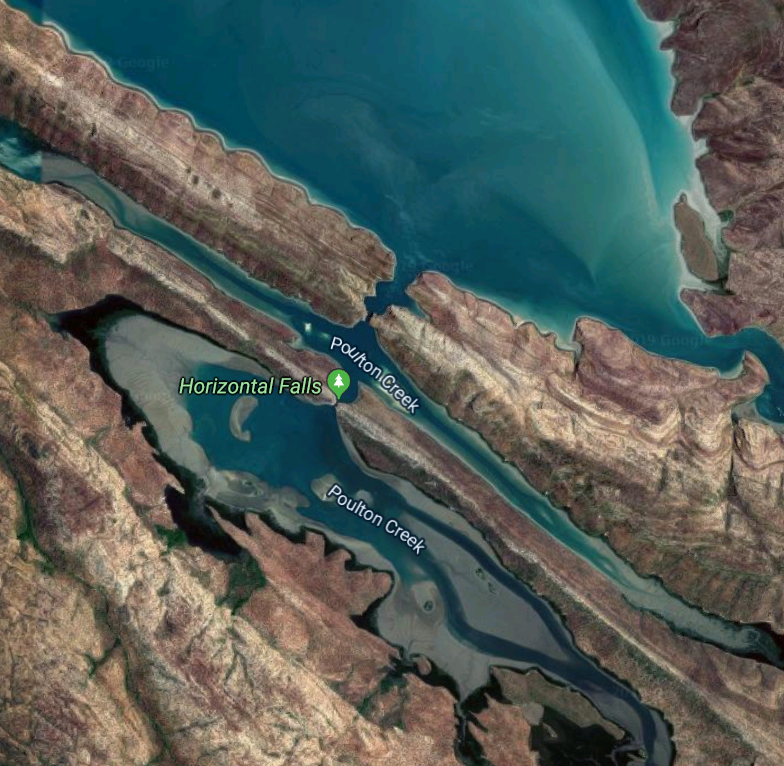
Recently I had the chance to tick one thing off my bucket list. Unlike people who consider climbing Mt Everest a must on the ‘to do’ list, even when you haven’t really got the necessary fitness levels but do have the money, (http://www.traveller.com.au/overcrowding-at-mount-everest-how-the-worlds-highest-mountain-became-a-tourist-attraction-h1f0gn), mine was a little safer and cheaper. I have wanted to see the Horizontal Falls in The Kimberley seen I first heard about them.

HF
Hyperlinked to Australia’s North West  Screenshot from Google Maps

I was back in Port Hedland for another round of school visits and had a long weekend so I drove up to Broome. If you have every done that trip, it really is 6 hours of boredom. There are some interesting spots along the way if you have the time for side trips; otherwise it’s pretty much flat with the occasional dump, river and floodplain. A new book that I’m keen to listen to, I find the best way to survive, particular travel by yourself.

The journey began next morning, getting picked up at my accommodation and taken to the airport where we boarded a single engine plane to fly to Cockatoo Island. The flight path takes you out over the Dampier Peninsula.

broometocockatoo_LI
Google maps (Accessed 15 June 2019)

The dry season had officially started and there tends to be a lot of burn off occurring so the atmosphere is pretty smoky. The Dampier Peninsula is mostly flat but once you fly out over King Sound and head for the Buccaneer Archipelago where Cockatoo Island is located, the landscape and geology changes.


Cockatoo Island is, in itself, a fascinating place; a former mine and exclusive resort, only a handful of people now live there and only during the dry season. Alan Bond built it but like so many big dreams in the eighties, it went belly up. Someone is trying to revive it at the moment.

After landing at the airstrip we headed for the beach and the boat. Cruising the old mining wharf was interesting. The iron ore is of such high quality that the company tried to follow the seam below sea level. It didn’t end well.

The trip out to the Horizontal Falls is fascinating, particularly if you are interested in geology. The rocks of the Kimberly were twisted and shoved up above the sea leaving amazing structures. My enthusiasm for the rocks can be directly blamed on my mum and the years of rock hound trips we were taken on as kids. I can’t go through a cutting with interesting geological structure without commenting on it.

The Horizontal Falls are actually two narrow gaps in the surrounding cliffs. The Kimberly experiences the some of the greatest tidal movements in the world, up to 12 meters. The amount of water (a great as one million litres of water per second) that attempts to rush through these gaps is greater than they can handle do water backs up creating a waterfall, whirlpools and an exhilarating boat ride. The boats can only pass through the larger gap as the narrowest gap is only 6 meters wide. The most spectacular view of the falls is from the other side of the narrowest gap as the water really backs up. People who take a tour that side don’t get to ride through the torrent as it is too dangerous. The tour I was on came in through the wider gap so we got to go through both ways of course about 3 times.

both gaps1
Both gaps – the narrower one is in the distance.

After that we headed back to Cockatoo Island, stopping for lunch and a walk on an island where the iron ore seam rising above sea level which creates a distinct division on one island, one side the beach is black sans, while the other is sand coloured sand.

20190504_13101720190504_130528

Once back, we boarded the plane and headed out towards the Horizontal Falls for a fly over before heading back to Broome.  Overall it was an excellent day and it was interesting to get a different view of Cable Beach.

from the air
Horizontal Falls from above

The following day, I drove to Derby, mainly because I had never been there; always interesting to visit a place you’ve heard about.  Derby wharf has one of the great tides in Australia and while the water of the King Sound is usefully crystal clear, at Derby it is muddy, caused by the sheer volume of water that gets moved around. I also visited the Prison Boab, which has an interesting if cultural scarred history. Boab trees are only found in the Kimberley and western Victoria Region of the Northern Territory.

A quick trip but really interesting as the difference between the countryside of the Pilbara and the Kimberley.  On the long boring trip back to Port Hedland stopped and watched a large cattle drive on the outskirts of Broome. Then somewhere between Pardoo and Port Hedland right by the side of the road I witnessed an amazing number of brolgas in a waterhole.  I have never seen so many in one place; it is usual 2 or 4 in one spot.  I couldn’t count how many were in this water hole.

cattle drivebrolgas